BSc Critical Care Technology Course Fees, Admission 2026, Syllabus, Top Colleges, Career Scope & Salary Details
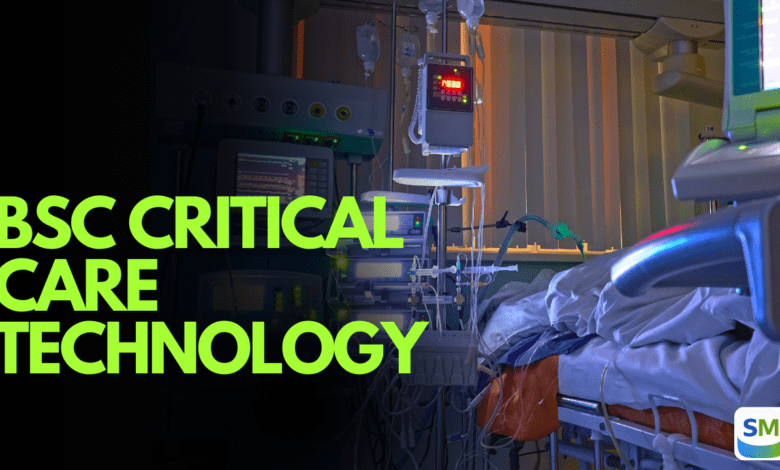
BSc Critical Care Technology could be your entry into a dynamic and essential field. In this guide, we’ll explore everything about the BSc Critical Care Technology Course Fees, Admission 2026, Syllabus, Top Colleges, Career Scope, and Salary Details, helping you make an informed decision for your future.
What Is BSc Critical Care Technology?
Bachelor of Science (BSc) in Critical Care Technology is a 3 to 4-year undergraduate program focused on training students to handle patients in critical medical conditions. The course teaches how to operate complex life-support equipment and monitor vital signs in ICUs, emergency departments, and trauma centers.
Students learn about medical procedures, healthcare equipment, and techniques to assist doctors during life-saving treatments. This makes Critical Care Technologists an integral part of hospital teams.
BSc Critical Care Technology Course Fees
The BSc Critical Care Technology course fees vary depending on the college type (government or private).
- Government Colleges: ₹25,000 – ₹75,000 per year
- Private Colleges: ₹1,00,000 – ₹2,50,000 per year
- Abroad Programs: USD 5,000 – 15,000 per annum (approx.)
In addition to tuition, students should budget for uniforms, books, lab access, and hospital training fees. Scholarships and financial aid options are available for meritorious students.
BSc Critical Care Technology Admission 2026: Process & Eligibility
Admission for the BSc Critical Care Technology Course 2026 session usually begins between April and August 2026 in India.
Eligibility Criteria:
- Must have passed 10+2 or equivalent from a recognised board.
- Required subjects: Physics, Chemistry, Biology (sometimes English).
- Minimum aggregate: 50% (45% for reserved categories).
- Age limit: 17 years minimum at the time of admission.
Admission Process:
- Apply online through the university or college website.
- Appear for entrance exams (specific to some institutes like AIIMS, JIPMER, or state-level universities).
- Shortlisted candidates attend counselling or interviews.
- Complete document verification and fee payment.
Top colleges may also accept NEET-UG or state-level medical entrance scores.
Top Colleges for BSc Critical Care Technology in India
Here are some of the top colleges offering BSc Critical Care Technology courses in India (2026):
- Christian Medical College (CMC), Vellore
- All India Institute of Medical Sciences (AIIMS), New Delhi
- Manipal Academy of Higher Education, Manipal
- Sri Ramachandra Institute of Higher Education and Research, Chennai
- Amrita Vishwa Vidyapeetham, Kochi
- Rajiv Gandhi University of Health Sciences, Bangalore
Abroad Options:
- University of Salford, UK
- Monash University, Australia
- University of Toronto, Canada
When exploring abroad programs, students must consider tuition, living costs, and language proficiency tests such as IELTS or TOEFL.
BSc Critical Care Technology Syllabus and Subjects
The BSc Critical Care Technology syllabus is designed to provide both theoretical and practical knowledge related to critical care procedures.
Year-wise Syllabus Overview:
First Year:
- Human Anatomy & Physiology
- Biochemistry
- Microbiology
- Fundamentals of Critical Care
- Basics of Computer Application
Second Year:
- Pathology
- Pharmacology
- Medical Ethics & Law
- Patient Monitoring Systems
- Clinical Practicum I
Third Year:
- Critical Care Techniques
- Emergency Medicine
- Cardiac Care Technology
- Research Methodology
- Clinical Practicum II
Internship (6–12 months):
Hands-on training in ICU, CCU, emergency units, and operating theatres under medical supervision.
Career Scope After BSc Critical Care Technology
A career in critical care technology offers high demand, job security, and growth opportunities in both India and abroad.
Job Roles:
- Critical Care Technologist
- ICU Technician
- Cardiac Care Technician
- Anesthesia Assistant
- Emergency Medical Technician
Industries Hiring:
- Multispecialty Hospitals
- Trauma Care Units
- Emergency Centers
- Research Organizations
- Private Healthcare Firms
With the expansion of advanced medical facilities, skilled technologists are increasingly valuable.
BSc Critical Care Technology Salary in India and Abroad
The average salary for a fresh BSc Critical Care Technology graduate in India ranges between ₹3 LPA to ₹6 LPA, depending on skill level and institution.
Salary Overview:
- Entry Level: ₹20,000 – ₹35,000 per month
- Mid-Level (3–5 years): ₹40,000 – ₹60,000 per month
- Senior Technologist: ₹70,000 – ₹1,00,000 per month
Abroad Salaries:
- USA: USD 50,000 – 90,000 per year
- UK: £25,000 – £45,000 per year
- Australia: AUD 60,000 – 85,000 per year
Higher Studies After BSc Critical Care Technology
After completing a BSc Critical Care Technology, students can pursue higher studies for specialisation or academic growth:
- MSc in Critical Care Technology
- MSc in Anaesthesia and Critical Care
- MBA in Hospital Management
- PG Diploma in Emergency Medicine
These advanced programs improve career prospects and open up roles in hospital administration, teaching, and research.
Study BSc Critical Care Technology Abroad
Studying this course abroad offers global exposure, advanced facilities, and international certification. Students can apply to universities in Canada, the UK, Australia, or the USA by submitting academic transcripts, English proficiency scores, and a statement of purpose (SOP).
Many universities offer internship-integrated programs that enhance employability after graduation.
Benefits of Pursuing BSc Critical Care Technology
- Strong job market with global opportunities.
- Professional respect and rewarding career.
- Access to advanced hospital environments.
- Career growth in both clinical and management fields.
- Ideal for students passionate about healthcare.
Frequently Asked Questions (FAQs)
1. What is the duration of the BSc Critical Care Technology course?
The course duration is 3 years plus 6–12 months of internship.
2. What is the average BSc Critical Care Technology Course Fee in India?
It ranges from ₹25,000 to ₹2,50,000 per year, depending on the institution.
3. Is NEET mandatory for admission in 2026?
Not always. Some top universities consider NEET, while others have their own entrance exams.
4. What are the job opportunities aftera BSc Critical Care Technology?
Graduates can work as ICU technologists, cardiac care technicians, or anaesthesia assistants in hospitals.
5. Can I study BSc Critical Care Technology abroad?
Yes. Countries like the UK, Canada, and Australia offer global-standard programs with great career prospects.
6. What is the salary after completing BSc Critical Care Technology?
Starting salaries range from ₹3–6 LPA in India and can go up to USD 90,000 abroad.
7. What higher studies options are available after a BSc Critical Care Technology?
Students can pursue an MSc, an MBA in Hospital Management, or specialised diplomas in Emergency Medicine.
Conclusion
A BSc in Critical Care Technology is one of the most promising healthcare courses for students after 12th science. With increasing hospital advancements and a growing need for skilled technologists, this field offers stability, respect, and international opportunities. Whether you aim to study in India or abroad, 2026 admissions present a great time to begin your journey toward a rewarding healthcare career.